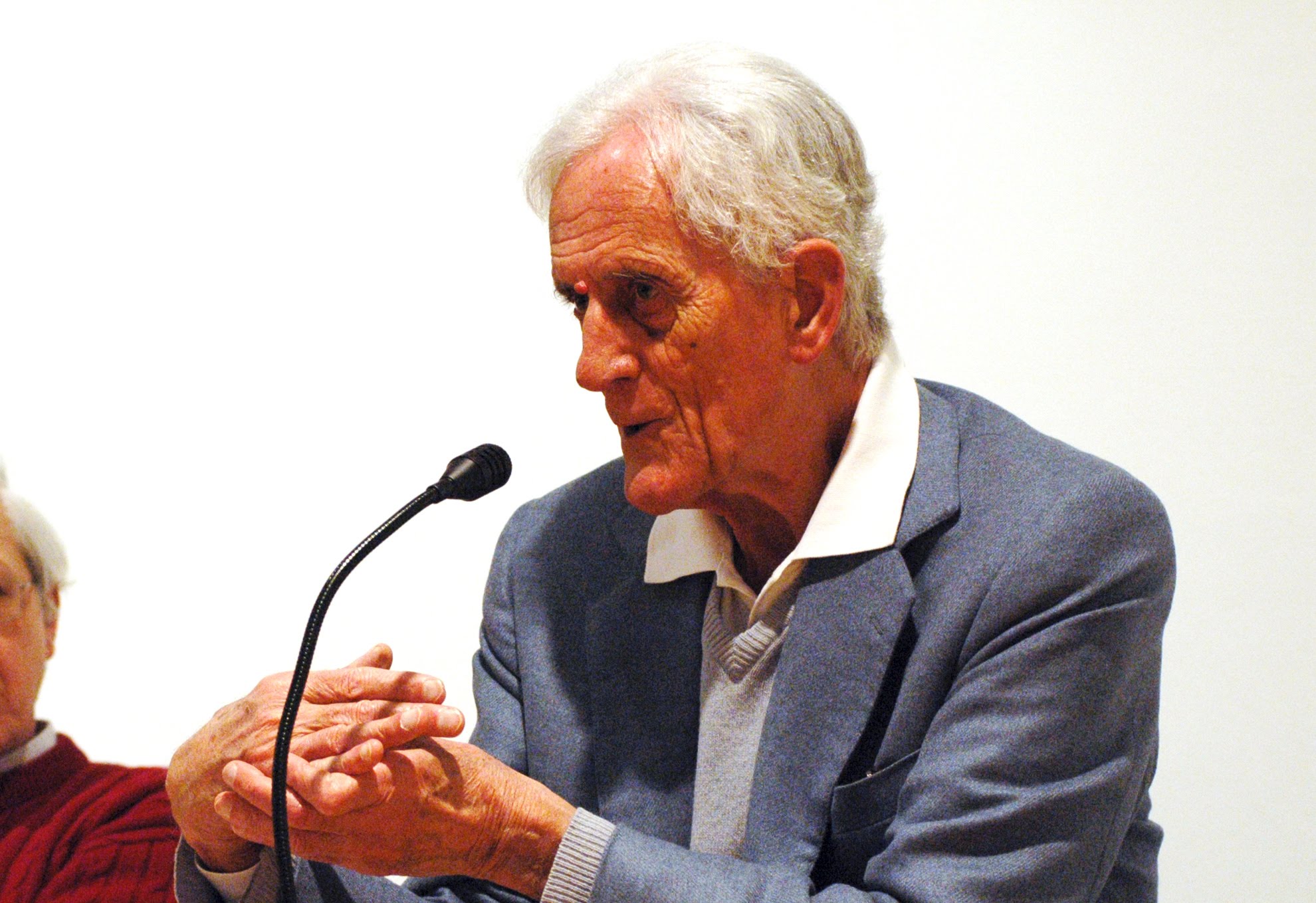
Green was introduced to Lacan in 1958 and he very quickly became “seduced” by his brilliance, kindness, and ultimately, his perversity. He found himself caught in triangular relationships set up by Lacan, with Green often being the preferred object. However, he was able to extricate himself, finally rejecting Lacan by 1967. One of his biggest criticisms of Lacan is that he was intellectually dishonest in his claim to represent a return to Freud, “ [He] cheated everybody… the return to Freud was an excuse, it just meant going to Lacan” (p. 24).
It was in the cauldron of French psychoanalytic thinking and politics and against a Lacanian backdrop, that Green laid the groundwork for his own enduring imprint on the changing map of psychoanalytic ideas. His independence of thought was demonstrated early on when, building on Diatkine, he boldly criticized Lacan for the damage done to psychoanalytic theory by insisting that the unconscious is structured as a language. Green’s interest in preserving the essential nature of the drives in human psychology led him to develop these ideas into a book, Le Discours vivant, enraging Lacan in the process. This book on affects was the beginning of Green’s growing and rich body of work in which he pushes the envelope of psychoanalytical critical thought.
He believed that “something had to be done” given that psychoanalysis was heavily under the sway of American ego psychology with its emphasis on adaptation. Green offered a focused rebuttal, by replenishing our appreciation of the Freudian imperatives of drives, negation, sexuality, and object relationships. The “biological roots of the mind” are the underpinnings of Green’s work as he repeatedly confronts the restrictions of narrowing schools of thought, especially the destructive impact of Lacan’s psychoanalytic nihilism, which threaten to ignore these sina qua non of Freudian psychoanalysis. Yet all the while, Green responds to and capitalizes on emerging ideas as dialectical mechanisms for his own Freudian elaborations. Two English (rather than French!) analysts are essential mainstays of these developments—Bion and Winnicott.
Green avers that psychoanalysis is based on the negative, that which is absent, that which is lost, and that which is always latent, much like the unconscious itself. Repression and representation are critical variables and in this way, Green enfolds Freud’s basic elements and actions of the mind to explain his own model. For Green, the negative is a normal, necessary aspect to development, likening his thinking to Winnicott’s interest in the absence of the mother in ordinary ways and Bion’s use of the representation of the maternal container to master separation.
the therapeutic encounter is a mess, so to speak, of sheer humanity…
Encounters through Generations: a conversation with Dr. Leslie Sohn
During his 62 years as a world-leading expert on the psychotic mind, Dr Leslie Sohn worked as a psychiatrist for the NHS and also as a psychoanalyst. He completed his psychoanalytic training at the Institute of Psychoanalysis in 1952 for whom he later became a Senior Training Analyst and Supervisor. Until 2010 (aged 91), he held the position of Consultant Psychiatrist at Broadmoor High Security Hospital and his work on violent offenses by mentally ill patients has been particularly influential.
A collection of his works is being prepared for publication and Dr Sohn’s monthly ‘Forensic Psychoanalysis’ seminar at the Institute of Psychoanalysis will now continue as the ‘Sohn Seminar’. We hope that you enjoy this ‘Encounters through the Generations’ film in which Dr Sohn discusses his life and work.
undisturbed friendly interest
J. T. could not tolerate the response to his enquiry “What is your trouble?”, “It’s my kidneys doctor.” “Kidneys! What do you know about kidneys!” (or liver, or stomach, or whatever other anatomical structure or physiological function to which the patient chose to refer). It offended both his medical knowledge and his sense of propriety. The patient, frightened at having given offence to such an eminent authority, would close up and volunteer no further suggestions lest a further storm be evoked.
Trotter, on the other hand, listened with unassumed interest as if the patient’s contributions flowed from the fount of knowledge itself. It took me years of experience before I learned that this was in fact the case. When a patient co-operates so far as actually to present himself for inspection, the doctor from whom help is being sought is being given the chance of seeing and hearing for himself the origin of the pain. No need to ask, “Where does it hurt?”— though it would clearly be a comfort to have his query answered in a language that he understands. The anger that is so easily aroused is the ‘helper’s’ reaction to an awareness that he does not understand the language, or that the language that he does understand is not the relevant one or is being employed in a manner with which he is unfamiliar. Trotter’s undisturbed friendly interest had the effect of eliciting further evidence from the patient; the fount of knowledge did not dry up.
It was said that when Trotter did a skin graft it ‘took’; if Taylor did a skin graft— with equal or maybe even greater technical brilliance and accuracy— it did not take; the body rejected it; it was sloughed off. This I did not see, but that the story was told was itself significant of the impression that was created by the two men on their students.
Bion, Wilfred R. (1991-12-31). All My Sins Remembered: Another Part of a Life & The Other Side of Genius: Family Letters (Kindle Locations 562-576). Karnac Books. Kindle Edition.
a perception of the invisible
You speak often of the “heart,” but not in sentimental terms, it seems to me.
E. Borgna: The “reasons of the heart” are those that move in St Augustine and that led even Heidegger to write that the essential things of life, i.e., birth, suffering, dying, can be grasped only if we leave behind the bright light of reason, acknowledging that there exists an alternative form of knowledge, which is the one of which Paschal or Scheler speaks, but also the Christian one, I believe. Proust identifies the reasons of the heart as intuition. But what is intuition? I usually give this example: a patient comes into the office, and even before he speaks, before he expresses something of his suffering, thanks to a perception of the invisible–which comes, without doubt, through looks, faces, the smiles that are sometimes tears, the tears that are sometimes smiles–you perceive instantly the deep core that is in him. How can an abstract, rational knowledge tell me something about the feelings, the emotions that others feel? What does rational knowledge have to do with the memory that makes me suddenly relive long-ago events–here is the “intermittent heart”–that are born again in that instant because the light I see this morning outside the window of my office is associated with the light I saw years ago over Monte Rosa, on another day, a day as crystalline and sunny as this one? God is perceptible by the heart and not by abstract reason, said Paschal.
(love and understanding) can heal the trauma
“Being alone leads to splitting. The presence of someone with whom one can share and communicate joy and sorrow (love and understanding) can heal the trauma” (Ferenczi, 1988, p. 200)
Judith Szekacs-Weisz (2012-09-10). Ferenczi for Our Time: Theory and Practice (The History of Psychoanalysis Series) (p. 103). Karnac Books. Kindle Edition.
edin balint on waiting and transference
Her place in the psychoanalytic firmament is an interesting one. In terms of psychoanalytic genealogy, she descends from Freud via Rickman (and less directly via Winnicott, who was analysed by Strachey), and from Ferenczi and the Hungarian tradition via, again, Rickman, with Balint added in; this background, together with more than a little respect for Klein’s thinking, creates a recipe for a unique position. Enid Balint’s own gifts, already available to her by the age of thirteen, and certainly visible to her schoolteachers, underlie these later influences, which gave rise to her own voice. To end, I would like to quote some of Enid’s own words, as spoken to another analysand, Juliet Mitchell, about her own way of analysing.
The small thing that the patient tells the analyst is probably not in itself what matters, but what matters is not some big thing either. What the small thing leads to may be some other very small thing, perhaps from the past. What often happens in analytic work is that the patient brings something about the neighbour smelling horrible, or something nasty in this particular room this morning; who has been there perhaps. You listen. You don’t say anything then; you don’t make an interpretation which turns it into something important, about the smell of a mother, or whatever. If you do that, you may be neglecting and misunderstanding the patient by understanding too quickly. You have to wait and see what it is about, and perhaps you find it is about a smell when the child was small, or perhaps something quite different. You don’t know to begin with, but if you come in too soon with an interpretation, you might miss a dream, for example, by interrupting the flow of association. In my view it’s much easier if you have an association, then maybe a dream, then more associations; and then you get back to the bad smell at the beginning. But if you come in too soon, you are doing what I am anxious about at the moment, both in general practice but more so, much more so, in analysis, which is that people may hang on to set-piece interpretation. I think we have given up the idea of its being all the Oedipus complex, or all parental neglect, or all anything. We get tiny little important details which really make things alive for the patient, and then, once you do that, the patient tells you something different and unexpected. That is the transference in the true sense.
Judith Szekacs-Weisz (2012-09-10). Ferenczi for Our Time: Theory and Practice (The History of Psychoanalysis Series) (pp. 97-98). Karnac Books. Kindle Edition.
we can not bully the psyche out of existence
Psychoanalysis is one attempt to see what we can do if we open more boxes, combining models of control with models of affective exploration and emotional transmission. Whatever its limitations and failures, psychoanalysis addresses aspects of psychic reality that must be grappled with. Attempts to outlaw or ban the psyche – by science, spirit, laughter, or shouting – delay the work that has to be done. Work unknown. We can not bully the psyche out of existence.
Michael Eigen (2006). Feeling Matters. Karnac Books.
what freud did for us as human beings
Allow me in conclusion to say something about Freud. His work, his discoveries of the unconscious, of resistance and transference have been compared to the discoveries made by Copernicus. This may be a useful comparison for scholars. But he did more for us as human beings. He discovered that apart from the human languages of sound and gesture there are hundreds of other languages a thousand times more important and true than the former, means of communication which bring people closer to each other. In the context of world history Freud did something that can only be compared to the work of the founders of religion if we have to make a comparison at all. He taught people new ways of understanding one another, he brought them closer together, he built a thousand bridges across the gap that separates human beings from each other, he gave to those who followed him a newer, deeper, happier, more childlike way of living, a new kind of loving and a new kind of believing. To know is to doubt, to believe is not to doubt. In science Freud forced us to doubt and reexamine everything we thought we knew up to then. In our personal lives he brought us a belief, the belief in loving one another. He increased in us the ability to get to know each other which results spontaneously and inevitably in a greater human love and respect for others, it reduces the compulsion to lie, offers the possibility of a greater freedom of living and reduces anxiety. I am glad I know him.
Georg Groddeck; ‘Das Es und die Psychoanalyse nebst allgemeinen Ausführungen zum damaligen wie heutigen Kongresswesen’ (The It and Psychoanalysis with general remarks about congress mania then and now), Psychoanalytische Schriften zur Psychosomatik, pp. 161-2.
the study of the unconscious is an affair of all mankind
Every year the belief — or rather superstition — that psychoanalysis is an affair for doctors, that it is a kind of psychiatric treatment which should be used for the patients’ best, is growing in strength. I consider it a necessary duty to fight against this erroneous belief by lecturing and writing, for if this opinion becomes prevalent — and unfortunately there are many people who defend this position — the world would be deprived of the most precious thing Freud gave it. The study of the unconscious — which is a possible translation of the term psychoanalysis — is an affair of all mankind and its use in medicine is only a small fraction of all that this study consists of. In order to make this clear I chose the four pieces of literature mentioned in the announcement — the Ring of the Nibelungs, Peer Gynt, Faust, and Struwwelpeter — as material for my talks, and in order not to make people think that I was dabbling in aesthetics I called these pieces textbooks. Yet this does not mean that I intend to give a course in psychoanalysis, with the help of these textbooks. Psychoanalysis cannot be taught, for the simple reason that it is innate in all of us, that it is a human ability like seeing or hearing. I rather feel like a bookseller who is asked for his advice about what books to read in order to be informed on this or that subject, a question which is indeed often put to me, because of the interest in psychoanalysis. And I must say that none of the current textbooks will inform you as easily, simply and thoroughly about the nature of psychoanalysis as will these four works of literature.
Georg Groddeck; ‘Der Ring’ (The Ring), Psychoanalytische Schriften zur Literatur und Kunst p. 135.