Tag: analysis
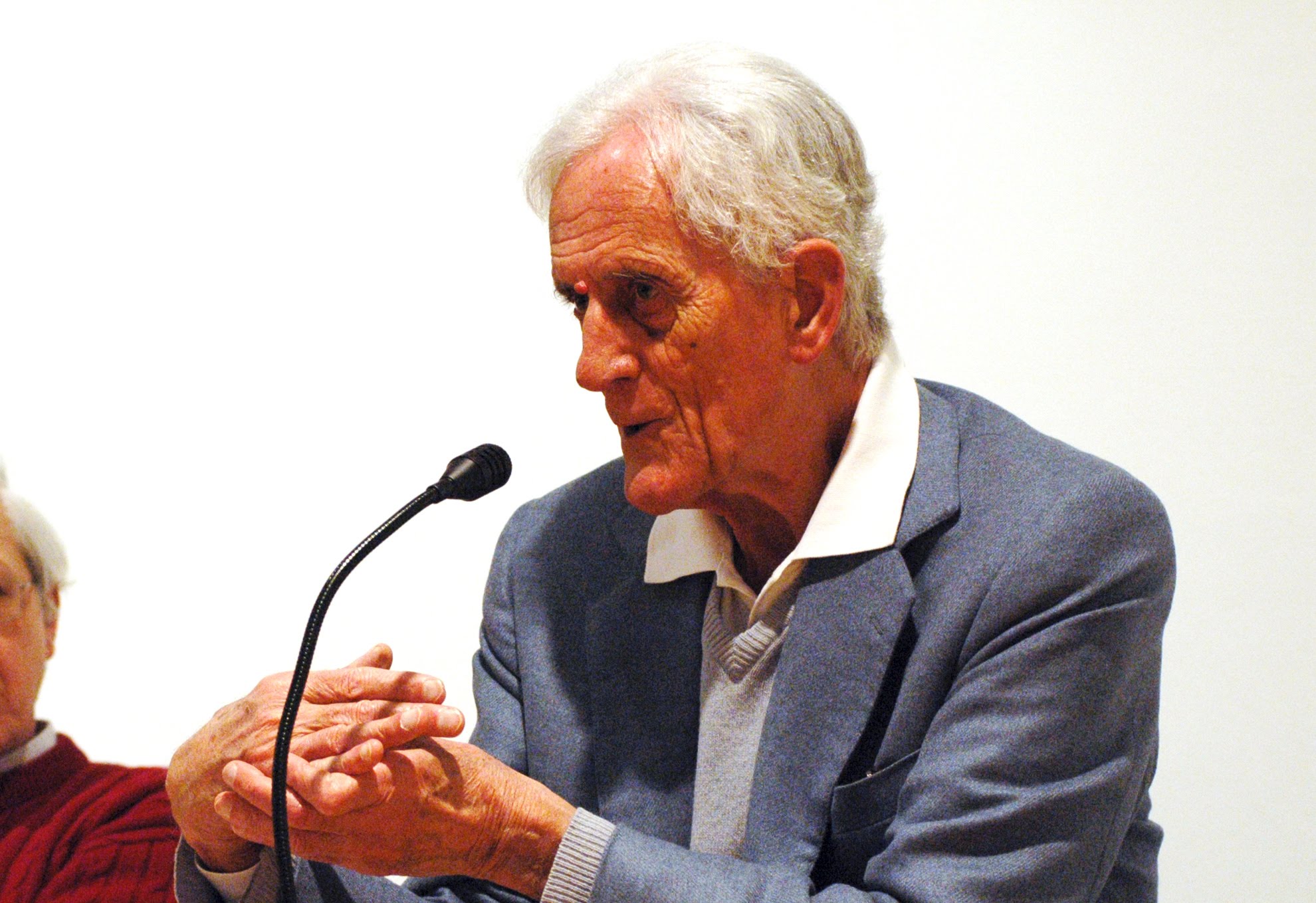
Encounters through Generations: a conversation with Dr. Leslie Sohn
During his 62 years as a world-leading expert on the psychotic mind, Dr Leslie Sohn worked as a psychiatrist for the NHS and also as a psychoanalyst. He completed his psychoanalytic training at the Institute of Psychoanalysis in 1952 for whom he later became a Senior Training Analyst and Supervisor. Until 2010 (aged 91), he held the position of Consultant Psychiatrist at Broadmoor High Security Hospital and his work on violent offenses by mentally ill patients has been particularly influential.
A collection of his works is being prepared for publication and Dr Sohn’s monthly ‘Forensic Psychoanalysis’ seminar at the Institute of Psychoanalysis will now continue as the ‘Sohn Seminar’. We hope that you enjoy this ‘Encounters through the Generations’ film in which Dr Sohn discusses his life and work.
a perception of the invisible
You speak often of the “heart,” but not in sentimental terms, it seems to me.
E. Borgna: The “reasons of the heart” are those that move in St Augustine and that led even Heidegger to write that the essential things of life, i.e., birth, suffering, dying, can be grasped only if we leave behind the bright light of reason, acknowledging that there exists an alternative form of knowledge, which is the one of which Paschal or Scheler speaks, but also the Christian one, I believe. Proust identifies the reasons of the heart as intuition. But what is intuition? I usually give this example: a patient comes into the office, and even before he speaks, before he expresses something of his suffering, thanks to a perception of the invisible–which comes, without doubt, through looks, faces, the smiles that are sometimes tears, the tears that are sometimes smiles–you perceive instantly the deep core that is in him. How can an abstract, rational knowledge tell me something about the feelings, the emotions that others feel? What does rational knowledge have to do with the memory that makes me suddenly relive long-ago events–here is the “intermittent heart”–that are born again in that instant because the light I see this morning outside the window of my office is associated with the light I saw years ago over Monte Rosa, on another day, a day as crystalline and sunny as this one? God is perceptible by the heart and not by abstract reason, said Paschal.
(love and understanding) can heal the trauma
“Being alone leads to splitting. The presence of someone with whom one can share and communicate joy and sorrow (love and understanding) can heal the trauma” (Ferenczi, 1988, p. 200)
Judith Szekacs-Weisz (2012-09-10). Ferenczi for Our Time: Theory and Practice (The History of Psychoanalysis Series) (p. 103). Karnac Books. Kindle Edition.
we can not bully the psyche out of existence
Psychoanalysis is one attempt to see what we can do if we open more boxes, combining models of control with models of affective exploration and emotional transmission. Whatever its limitations and failures, psychoanalysis addresses aspects of psychic reality that must be grappled with. Attempts to outlaw or ban the psyche – by science, spirit, laughter, or shouting – delay the work that has to be done. Work unknown. We can not bully the psyche out of existence.
Michael Eigen (2006). Feeling Matters. Karnac Books.
the one collaborator in analysis
What I want to draw attention to is this idea that the human animal has a mind, or a character, or a personality. It seems to be quite a useful theory, and we behave as if we thought it was more than that. When it comes to being psychoanalysts and psychiatrists, this cannot be treated as if it were simply an entertaining theory. Nor do patients come to see us because they are suffering from an entertaining theory. We could say that there is one collaborator we have in analysis on whom we can rely, because he behaves as if he really had a mind and because he thought that somebody not himself could help. In short, the most important assistance that a psychoanalyst is ever likely to get is not from his analyst, or supervisor, or teacher, or the books that he can read, but from his patient. The patient—and only the patient—knows what it feels like to be him or her. The patient is also the only person who knows what it feels like to have ideas such as that particular man or woman has. That is why it is so important that we should be able to hear, see, smell, even feel what information the patient is trying to convey. He is the only one who knows the facts; therefore, those facts are going to be the main source of any interpretation, any observation, which we are likely to be able to make.
Wilfred Bion, Italian Seminars, Seminar 1 Rome, 8 July 1977 Copyright © 2005 The Estate of Wilfred R. Bion
the artistic or aesthetic capacity
Q. Would you speak about the religious cult and the aesthetic impulse, and the relationship between them.
Bion. In psycho-analysis, and even in ordinary conversation, one is always talking about religion or art or business, all of which is very useful if you want to talk; it is another matter if you want to talk about the thing itself. You can easily feel from your own experience that these watertight compartments of categories have a lot to do with human thinking but very little to do with the universe in which we live. Nevertheless, however ignorant or mistaken we may be, we can feel that religion and art have often worked closely together. The same can be said for psycho-analysis insofar as it can be regarded as an attempt at a scientific approach. Sooner or later one will feel that one knows the interpretation but does not know what to say to the patient, or how to say it. At this point the psycho-analyst would gain if he could be an artist and express himself, as Freud could, in terms which are easily appreciated as being highly artistic. Even Plato, while critical of artists and poets as people who are always misleading their fellows by telling lies, nevertheless expressed things, in the Socratic Dialogues, in a way which no artist has since excelled—and yet he might be supposed to have been opposed to the artist. This kind of conflicting view is common; the artistic or aesthetic capacity seeps into the expressions of those who want to be purely scientific; and the artist, reciprocally, can discern the science in his art. [See p. 44. Sometimes he can even consciously aspire to a ‘golden number’, as with Leonardo da Vinci, Durer etc.]
Wilfred Bion, Sao Paulo Seminar 1973 (Brazilian Lectures, Karnac Books, Reprinted 2008, Copyright © 1990)
the psychoanalytic attitude of faith
I am not a Kabbalah scholar, but aspects of its teachings have become part of me, as has psychoanalytic work. The two have many points of convergence. The main psychoanalytic writer I use in this work is Bion, partly because of his striking statement that he uses Kabbalah as a framework for psychoanalysis, but largely because it is hard to miss connections between the two. Both are preoccupied with catastrophe and faith. Bion calls faith the psychoanalytic attitude. Both are preoccupied with infinity and intensity of experience. Both are preoccupied with shatter and the possibility of bearing and growing the kind of psyche that can work with the dimensions sensitivity opens. Both are preoccupied with ontological implications of the Unknown and the importance of emotional life. Bion, too, writes penetratingly about an ongoing crises of faith, basic to Kabbalah concerns.
As in all of my work, D. W. Winnicott plays an important background role. His writings on vital sparks connect with Kabbalah’s buried divine sparks scattered everywhere. His incommunicado core connects with Kabbalah’s Ein Sof, the infinite beyond bounds and conception. For Winnicott, too, faith is important, what I call a paradoxical faith (Eigen, 1998) because it spans and opens diverse dimensions without reductively taking sides. Winnicott also writes of the importance of creative illusion, which adds to richness of living, even helps one feel alive. He locates illusion in transitional experiencing, which takes different forms as one grows. It might be that what we call self is, partly, a transitional state, which, like dolls, games, hobbies of childhood, lose meaning as one grows. We outgrow self-identities once treasured as new dimensions of experience open and take us forward. Yet, paradoxically, old self-states might deepen when we touch them with who we are now.
Eigen, Michael (2012-07-02). Kabbalah and Psychoanalysis (Kindle Locations 74-87). Karnac Books. Kindle Edition.
the aesthetic element of beauty
“It is very important to be aware that you may never be satisfied with your analytic career if you feel that you are restricted to what is narrowly called a ‘scientific’ approach. You will have to be able to have a chance of feeling that the interpretation you give is a beautiful one, or that you get a beautiful response from the patient. This aesthetic element of beauty makes a very difficult situation tolerable. It is so important to dare to think or feel whatever you do think or feel, never mind how un-scientific it is.”
the totality of debris
Q: Are you suggesting that the analytic experience can be a dehumanising once?
Bion: I think that there is a great danger of it. I come across a lot of what is thought to be scientific psychoanalysis, but it doesn’t remind me of anything except boredom.
The situation in the consulting room, the relationship between these two people, could be like the ashes of a fire. Is there any spark which could be blown into a flame? In this little bit I have described, we would have to examine, observe, devote care to mental debris – bits of what we have been taught, bits of what we have learnt, bit of what the patient has been taught. In analysis one is seeing the totality of debris. What has happened to the face of a man of forty-two? Why does he look twenty-five or sixty-two? Why does he say he is forty-two? It is all part of the debris. Do those pieces come together? Would you be able to put them together so that they make sense?
Q. (an inaudible reference, to ‘psychotic experience’)
Bion: The idea that it is a psychotic experience is very cerebral. In analysis we are concerned with something which might ultimately be expressible in cerebral terms, but that is not how it appears to us as practising analysts. That is one reason why we have to reconcile ourselves to the fact that patients do not come to us with little labels tied to them saying, ‘manic’, or ‘depressive’, or ‘manic-depressive’, or ‘schizophrenic’. If they do come with such labels we should regard them as more pieces of debris. I do not mean by calling it debris that it is not worthy of attention; I mean that it is something which has to be observed and scrutinized with very considerable care, otherwise you might throw away the necessary, vital spark. One cannot afford to cast aside imaginative conjectures on the grounds that they are not scientific – you might as well throw away the seed of a plant on the grounds that it is not an oak or a lily but just a piece of rubbish. This applies to all that goes on in your consulting room.
But I suggest that it would be worthwhile considering it not as your consulting room, but as your atelier. What sort of artist are you? Are you a potter? A painter? A musician? A writer? In my experience a great many analysts don’t really know what sort of artists they are.
Q. What if they are not artists?
Bion: Then they are in the wrong job. I don’t know what job is any good because even if they are not psychoanalysts they need to be artists in life itself. A mathematician can see that an algebraic formula is a beautiful one; a musician can hear a manuscript which is simply black marks on paper. Even using the language I know best, I cannot tell you what an ‘artist’ is; I prefer you to go beyond that word and see what I am trying to convey to you by this very inadequate word. It is certainly not somebody who is able to deceive your eyes, to make you think that there is a tree there when there isn’t one, but somebody who has made you able to see there really is a tree there and its roots even if they are underground.
I suggest that behind this forty-two-year-old man is hidden a person, and that person has roots, an unconscious which, Like the roots of a tree, is hidden from sight. There are not only branches which are ramified and have veins, but under the surface it has roots. So when this person comes into your room, what do you see? I am not asking simply what do you see with your eyes, but also what does your intuition enable you to see?